what do you call a persons eyes that change from blue to green to grey
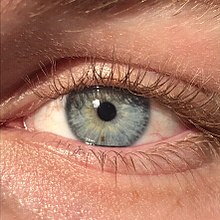
Middle color is a polygenic phenotypic character determined by two distinct factors: the pigmentation of the eye's iris[1] [two] and the frequency-dependence of the scattering of calorie-free by the turbid medium in the stroma of the iris.[3] : ix
In humans, the pigmentation of the iris varies from lite brown to black, depending on the concentration of melanin in the iris paint epithelium (located on the back of the iris), the melanin content within the iris stroma (located at the front of the iris), and the cellular density of the stroma.[4] The advent of blue and dark-green, likewise as hazel eyes, results from the Tyndall scattering of light in the stroma, a miracle similar to that which accounts for the blueness of the heaven chosen Rayleigh handful.[v] Neither blue nor green pigments are ever present in the human iris or ocular fluid.[3] [half dozen] Middle color is thus an instance of structural colour and varies depending on the lighting conditions, especially for lighter-colored optics.
The brightly colored optics of many bird species upshot from the presence of other pigments, such equally pteridines, purines, and carotenoids.[7] Humans and other animals accept many phenotypic variations in eye color.[8]
The genetics and inheritance of eye color in humans is complicated. So far, as many equally 15 genes have been associated with eye colour inheritance. Some of the heart-color genes include OCA2 and HERC2.[9] The earlier belief that blue eye colour is a simple recessive trait has been shown to be incorrect. The genetics of eye color are and so complex that nearly any parent-child combination of eye colors can occur.[10] [11] However, OCA2 factor polymorphism, close to proximal v' regulatory region, explains nigh homo eye-color variation.[12]
Genetic determination
Eye colour is an inherited trait influenced by more one gene.[13] [xiv] These genes are sought using associations to small changes in the genes themselves and in neighboring genes. These changes are known every bit single-nucleotide polymorphisms or SNPs. The actual number of genes that contribute to eye color is currently unknown, merely there are a few likely candidates. A study in Rotterdam (2009) found that it was possible to predict heart color with more than xc% accuracy for brown and blue using simply six SNPs.[fifteen] There is evidence that as many equally sixteen different genes could be responsible for eye color in humans; however, the main two genes associated with eye color variation are OCA2 and HERC2, and both are localized in Chromosome 15.[ix]
The gene OCA2 (OMIM: 203200), when in a variant form, causes the pink middle color and hypopigmentation common in human albinism. (The name of the gene is derived from the disorder it causes, oculocutaneous albinism type II.) Different SNPs within OCA2 are strongly associated with blue and greenish optics as well as variations in freckling, mole counts, pilus and peel tone. The polymorphisms may be in an OCA2 regulatory sequence, where they may influence the expression of the cistron product, which in turn affects pigmentation.[12] A specific mutation within the HERC2 cistron, a cistron that regulates OCA2 expression, is partly responsible for blue eyes.[16] Other genes implicated in heart color variation are SLC24A4[17] and TYR.[17] A 2010 study on center color variation into hue and saturation values using high-resolution digital full-middle photographs found three new loci for a total of ten genes, and now near l% of heart colour variation can be explained.[xviii]
| Gene name | Issue on center color |
|---|---|
| OCA2 | Associated with melanin producing cells. Key importance to eye color. |
| HERC2 | Affects function of OCA2, with a specific mutation strongly linked to blue eyes. |
| SLC24A4 | Associated with differences betwixt blue and green eyes.[17] |
| TYR | Associated with differences between blueish and green eyes.[17] |
Blue eyes with a dark-brown spot, green optics, and gray eyes are acquired past an entirely different part of the genome.
Ancient Dna and middle color in Europe
People of European descent bear witness the greatest variety in centre color of any population worldwide. Recent advances in ancient Dna technology have revealed some of the history of centre colour in Europe. All European Mesolithic hunter-gatherer remains then far investigated have shown genetic markers for calorie-free-colored optics, in the instance of western and primal European hunter-gatherers combined with night pare color. The afterwards additions to the European factor pool, the Early Neolithic farmers from Anatolia and the Yamnaya Copper Age/Bronze Historic period pastoralists (possibly the Proto-Indo-European population) from the area north of the Black Body of water appear to take had much higher incidences of night eye color alleles, and alleles giving ascent to lighter pare, than the original European population.[nineteen] [20]
Classification of color
Iris colour can provide a large amount of data about a person, and a classification of colors may be useful in documenting pathological changes or determining how a person may respond to ocular pharmaceuticals.[21] Nomenclature systems have ranged from a basic calorie-free or dark description to detailed gradings employing photographic standards for comparison.[21] Others accept attempted to set objective standards of color comparison.[22]
Normal middle colors range from the darkest shades of chocolate-brown to the lightest tints of blue.[13] To run into the need for standardized classification, at once simple yet detailed enough for enquiry purposes, Seddon et al. developed a graded system based on the predominant iris color and the amount of brown or xanthous pigment present.[23] There are three pigment colors that decide, depending on their proportion, the outward appearance of the iris, along with structural color. Green irises, for instance, have some yellow and the blue structural colour. Brown irises contain more or less melanin. Some eyes take a dark band around the iris, called a limbal band.
Eye color in non-human animals is regulated differently. For example, instead of blue as in humans, autosomal recessive eye colour in the skink species Corucia zebrata is black, and the autosomal dominant colour is yellow-greenish.[24]
As the perception of color depends on viewing weather condition (e.g., the amount and kind of illumination, as well as the hue of the surrounding environs), then does the perception of centre color.[25]
Changes in eye color
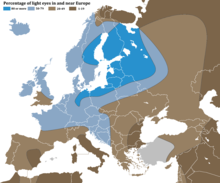
Percentage of light eyes in and nearly Europe according to anthropologist Peter Frost.[26]
lxxx+
l-79
20-49
ane-xix
Most newborn babies who accept European ancestry accept lite-colored optics. As the child develops, melanocytes (cells found within the iris of human eyes, as well as skin and hair follicles) slowly begin to produce melanin. Because melanocyte cells continually produce pigment, in theory centre color can be inverse. Adult eye color is normally established between iii and 6 months of age, though this tin can be afterwards.[27] Observing the iris of an infant from the side using just transmitted calorie-free with no reflection from the dorsum of the iris, it is possible to detect the presence or absence of low levels of melanin. An iris that appears bluish under this method of observation is more probable to remain blue every bit the infant ages. An iris that appears golden contains some melanin even at this early historic period and is likely to plow from blueish to green or brown every bit the infant ages.
Changes (lightening or darkening) of heart colors during early on childhood, puberty, pregnancy, and sometimes after serious trauma (like heterochromia) do stand for cause for a plausible argument stating that some eyes can or do alter, based on chemical reactions and hormonal changes within the body.
Studies on Caucasian twins, both congenial and identical, take shown that eye color over time can be discipline to change, and major demelanization of the iris may as well be genetically determined. Most heart color changes have been observed or reported in the Caucasian population with hazel and bister eyes.[28] Nether the same ecology conditions, in that location may exist disagreement over the colour of an object between 2 dissimilar people;[ further explanation needed ] the gene that causes this discrepancy is the presence of melanin in the iris, which is the main factor in determining eye color. The higher the amount of melanin in the iris and the denser the texture of the melanin, the darker the color of a person's eyes; the same melanin concentration besides depends on many factors such equally hereditary and ecology ones.
The most of import part of melanin in the iris is to protect the eyes from the lord's day's harmful rays.[29] People with lighter eye colors, such every bit blueish or green, have lessened protection from the sun, and and so need greater protection from the sun'southward rays than those with darker eye colors.[ citation needed ]
The homo eye consists of two types of low-cal and color receptors in the retina. Cylindrical cells are the photoreceptors of the eye that have a black and white vision and, depending on the amount of calorie-free received from the environment, determine the corporeality of darkness and brightness of objects. The number of cylindrical cells is more than the number of color receptors and reaches about 120 million; cone cells, which are smaller in number than light receptors, have color vision and are divided into three distinct categories, each of which recognizes one of the colors blue, ruby, and dark-green, assuasive the private to distinguish colors.[thirty]
When a person is exposed to sunlight, the rays of sunlight hit a part of the back of the center chosen the 'yellow spot'. The cylindrical cells receive these rays, make a neural message from them, and ship them to the occipital region of the brain, where they are examined and answered if necessary. At this time, a large amount of ultraviolet light is received by the eye and destroys parts of the light receptors.[31] Because people with bright eyes have less melanin in their eyes than people with night eyes, the lack of this protective factor means that the calorie-free receptors in their eyes are more damaged and destroyed than in other people. This deviation in the number of light receptors in the optics of different people causes a difference in the amount of light they receive from the environs; for this reason, people with bright optics meet colors a little darker than others. However, this amount is and then pocket-sized that information technology is not very visible in everyday life and only appears as a slight deviation of opinion between people with different eye colors.[ citation needed ]
Eye colour nautical chart (Martin calibration)
Carleton Coon created a chart by the original Martin scale. The numbering is reversed on the scale below in the (later) Martin–Schultz scale, which is (all the same) used in physical anthropology.
Light and light-mixed eyes (16–12 in Martin scale)
Pure low-cal (16–15 in Martin scale)
- 16: pure lite blue
- xv: gray
Lite-mixed (14–12 in Martin scale)
- 14: Very light-mixed (blue with gray or green or green with grayness)
- 13-12: Low-cal-mixed (lite or very calorie-free-mixed with small admixture of brown)
Mixed optics (11–vii in Martin scale)
- Mixture of low-cal eyes (bluish, grayness or green) with chocolate-brown when light and brown appearance is at the same level
Dark and night-mixed eyes (6–1 in Martin calibration)
- Dark-mixed: 6–5 in Martin scale. Brown with small-scale admixture of light
- Dark: 4–one in Martin calibration. Brown (light brown and night brown) and very dark brown (near black)
Amber

Amber optics are of a solid color and have a strong yellowish/aureate and russet/coppery tint. This may be due to the deposition of the xanthous paint called lipochrome in the iris (which is also establish in green eyes).[32] [33] Amber eyes should not be confused with hazel eyes; although hazel eyes may contain specks of amber or gold, they usually tend to contain many other colors, including green, brown and orangish. Also, hazel eyes may announced to shift in color and consist of flecks and ripples, while bister eyes are of a solid golden hue. Fifty-fifty though amber is considered to be like golden, some people have russet or copper colored bister eyes that many people error for hazel, though hazel tends to be duller and contains green with red/gold flecks, as mentioned in a higher place. Amber eyes may also contain amounts of very light gilt-ish gray.
The eyes of some pigeons contain xanthous fluorescing pigments known as pteridines.[34] The bright yellow optics of the great horned owl are idea to be due to the presence of the pteridine paint xanthopterin within certain chromatophores (called xanthophores) located in the iris stroma.[35] In humans, yellowish specks or patches are thought to be due to the pigment lipofuscin, also known as lipochrome.[36] Many animals such equally canines, domestic cats, owls, eagles, pigeons and fish have amber eyes every bit a common color, whereas in humans this color occurs less frequently. With a world population share of 5%,[37] amber eyes are uncommon anywhere in the globe. People with that eye color are constitute in the Balkan region, as well equally in Republic of hungary, in Southern France, Italian republic, and to a lesser caste in the Iberian Peninsula, Southern Cone and Middle Due east. In Brazil, it can exist found particularly in the Southern Region, as well equally in São Paulo, Minas Gerais and other places that received strong European immigration.
Blue
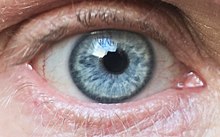
There is no blue pigmentation either in the iris or in the ocular fluid. Autopsy reveals that the iris pigment epithelium is brown black due to the presence of melanin.[38] Different brown eyes, blue eyes have low concentrations of melanin in the stroma of the iris, which lies in front of the dark epithelium. Longer wavelengths of light tend to be absorbed by the night underlying epithelium, while shorter wavelengths are reflected and undergo Rayleigh scattering in the turbid medium of the stroma.[4] This is the same frequency-dependence of scattering that accounts for the bluish appearance of the sky.[3] : nine [6] The issue is a "Tyndall blue" structural color that varies with external lighting conditions.
In humans, the inheritance pattern followed by blue eyes is considered similar to that of a recessive trait (in general, heart color inheritance is considered a polygenic trait, meaning that it is controlled by the interactions of several genes, not just ane).[14] In 2008, new inquiry tracked downward a single genetic mutation that leads to blue eyes. "Originally, nosotros all had brown eyes," said Eiberg.[39] Eiberg and colleagues suggested in a report published in Man Genetics that a mutation in the 86th intron of the HERC2 factor, which is hypothesized to interact with the OCA2 gene promoter, reduced expression of OCA2 with subsequent reduction in melanin production.[40] The authors suggest that the mutation may have arisen in the northwestern role of the Blackness Ocean region, and add that it is "difficult to calculate the age of the mutation."[39] [40] [41]
Bluish eyes are common in northern and eastern Europe, particularly around the Baltic Sea. Blue eyes are likewise establish in southern Europe, Central Asia, South Asia, Due north Africa and W Asia.[42] [43]
-

-
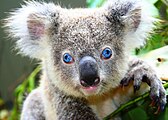
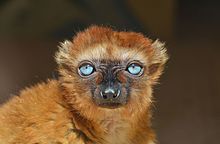
The outset blue-eyed koala known to be born in captivity[44]

Histrion Daniel Craig featuring the well-nigh mutual colour of eyes in the United Kingdom: 48% of the population had bluish eyes in 2014 (thirty% had green, and 22% brown).[45]
The same DNA sequence in the region of the OCA2 cistron among blue-eyed people suggests they may have a single common ancestor.[46] [47] [48]
As of 2016[update], the earliest remains of Homo sapiens with genes for both light-pigmentation and blue-optics were establish in 7,700 years old Mesolithic hunter-gatherers from Motala, Sweden.[49]
Approximately 8% to 10% of the global population take blue eyes.[fifty] A 2002 report institute that the prevalence of blue center color amongst the white population in the United states to exist 33.viii% for those born from 1936 through 1951, compared with 57.four% for those born from 1899 through 1905.[14] As of 2006[update], one out of every 6 Americans, or 16.six% of the total Us population, has blue eyes,[51] including 22.3% of whites. Bluish eyes are continuing to become less mutual amongst American children.[52] 56% of Slovenes have blue/light-green optics.[53]
Brown

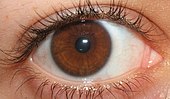
Light brown iris can be found in Europe, Westward Asia, South asia, Cardinal Asia and among the Americas.
In humans, brown eyes outcome from a relatively high concentration of melanin in the stroma of the iris, which causes low-cal of both shorter and longer wavelengths to be absorbed.[54]
Dark brown eyes are dominant in humans[55] and in many parts of the globe, it is well-nigh the only iris colour present.[56] Brown optics are mutual in Europe, Eastern asia, Southeast Asia, Primal Asia, Southern asia, West Asia, Oceania, Africa and the Americas.[17] Brown is by far the nigh common eye color, with approximately 79% of people in the world having it.[50]
Light or medium-pigmented brown eyes can also be usually found in South Europe, among the Americas, and parts of Cardinal Asia, West Asia and South Asia.
Grayness

Like blue eyes, gray eyes have a dark epithelium at the dorsum of the iris and a relatively clear stroma at the front. One possible explanation for the deviation in the advent of grey and blue eyes is that gray eyes have larger deposits of collagen in the stroma, so that the light that is reflected from the epithelium undergoes Mie handful (which is not strongly frequency-dependent) rather than Rayleigh handful (in which shorter wavelengths of low-cal are scattered more). This would be coordinating to the change in the colour of the sky, from the blueish given by the Rayleigh scattering of sunlight by minor gas molecules when the sky is clear, to the gray caused past Mie scattering of big water droplets when the heaven is cloudy.[57] Alternatively, it has been suggested that gray and blueish optics might differ in the concentration of melanin at the front of the stroma.[57]
Gray eyes can also be found amongst the Algerian Shawia people[58] of the Aurès Mountains in Northwest Africa, in the Middle East/West Asia, Central Asia, and South asia. The Greek goddess Athene appears with gray eyes (γλαυκῶπις).[59] Under magnification, grayness eyes showroom small amounts of yellow and brown color in the iris.
Gray is the second-rarest natural eye color afterwards green, with 3% of the globe'south population having it.[threescore]
Green


Equally with blueish eyes, the color of green eyes does non result simply from the pigmentation of the iris. The green color is caused past the combination of: ane) an amber or lite brown pigmentation in the stroma of the iris (which has a depression or moderate concentration of melanin) with: ii) a blue shade created past the Rayleigh handful of reflected lite.[54] Light-green optics incorporate the xanthous pigment lipochrome.[61]
Light-green eyes probably result from the interaction of multiple variants within the OCA2 and other genes. They were present in south Siberia during the Bronze Age.[62]

They are well-nigh mutual in Northern, Western and Fundamental Europe.[63] [64] In Scotland, 29% of people have green eyes.[65] Around viii-ten% of men and 18-21% of women in Iceland and 6% of men and 17% of women in the Netherlands, have dark-green optics.[66] Amongst European Americans, green eyes are most mutual amidst those of recent Celtic and Germanic ancestry, nigh 16%.[67] forty.8% of Italians from Verona, 22.5% of Spaniards from Alicante and 15.4% of Greeks from Athens have green, gray, and blue eyes.[68] Globally, however, green is considered the rarest natural eye color; merely 2% of the world's population have it.[50]
Hazel


Hazel eyes are due to a combination of Rayleigh scattering and a moderate amount of melanin in the iris' anterior border layer.[4] [36] Hazel eyes often appear to shift in colour from a brown to a greenish. Although hazel more often than not consists of chocolate-brown and green, the ascendant colour in the centre can either be brownish/gold or green. This is how many people mistake hazel optics to be amber and vice versa.[69] [seventy] [71] [72] [73] [74] [75] This can sometimes produce a multicolored iris, i.east., an eye that is light brown/amber near the pupil and charcoal or dark green on the outer part of the iris (or vice versa) when observed in sunlight.
Definitions of the eye color hazel vary: it is sometimes considered to be synonymous with calorie-free brown or gilt, equally in the color of a hazelnut vanquish.[69] [71] [74] [76]
Around 18% of the US population and 5% of the world population take hazel eyes.[50]
Special cases
Ruby and violet

"Cerise"-appearing albino optics
The eyes of people with astringent forms of albinism may announced cerise under certain lighting conditions owing to the extremely low quantities of melanin,[77] allowing the blood vessels to show through. In addition, flash photography can sometimes cause a "red-middle effect", in which the very bright light from a flash reflects off the retina, which is abundantly vascular, causing the pupil to appear red in the photo.[78] Although the deep bluish optics of some people such as Elizabeth Taylor can announced violet at sure times, "true" violet-colored eyes occur just due to albinism.[79] [ unreliable source? ] Eyes that appear red or violet under certain conditions due to albinism are less than 1 per centum of the globe'due south population.[80]
Ii different colors

As a outcome of heterochromia iridum, it is also possible to accept two dissimilar middle colors. This occurs in humans and certain breeds of domesticated animals and affects less than 1 percent of the world'southward population.[80]
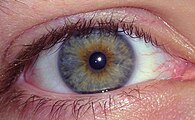
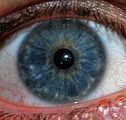
Spectrum of middle colour


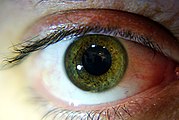


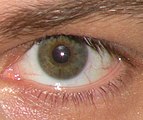

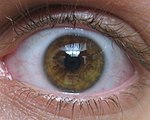


Medical implications
Those with lighter iris colour have been plant to have a higher prevalence of age-related macular degeneration (ARMD) than those with darker iris color;[73] lighter eye color is too associated with an increased risk of ARMD progression.[81] A gray iris may indicate the presence of a uveitis, and an increased risk of uveal melanoma has been constitute in those with blue, dark-green or gray eyes.[82] [83] Even so, a study in 2000 suggests that people with dark chocolate-brown eyes are at increased run a risk of developing cataracts and therefore should protect their optics from direct exposure to sunlight.[84]
Wilson'south disease

Wilson'due south disease involves a mutation of the factor coding for the enzyme ATPase 7B, which prevents copper within the liver from inbound the Golgi appliance in cells. Instead, the copper accumulates in the liver and in other tissues, including the iris of the center. This results in the formation of Kayser–Fleischer rings, which are dark rings that encircle the periphery of the iris.[85]
Coloration of the sclera
Eye color outside of the iris may also exist symptomatic of disease. Yellowing of the sclera (the "whites of the eyes") is associated with jaundice,[86] and may exist symptomatic of liver diseases such as cirrhosis or hepatitis.[87] A bluish coloration of the sclera may as well be symptomatic of disease.[86]
Aniridia
Aniridia is a built condition characterized by an extremely underdeveloped iris, which appears absent on superficial exam.[88]
Ocular albinism and eye color
Normally, at that place is a thick layer of melanin on the back of the iris. Fifty-fifty people with the lightest blue eyes, with no melanin on the front end of the iris at all, have dark brown coloration on the back of it, to prevent lite from handful around inside the heart. In those with milder forms of albinism, the colour of the iris is typically bluish but can vary from blue to brown. In severe forms of albinism, in that location is no paint on the back of the iris, and light from inside the eye tin can pass through the iris to the front. In these cases, the only color seen is the cherry-red from the hemoglobin of the blood in the capillaries of the iris. Such albinos have pinkish eyes, as do albino rabbits, mice, or any other animal with a full lack of melanin. Transillumination defects tin can almost ever be observed during an eye exam due to lack of iridial pigmentation.[89] The ocular albino also lacks normal amounts of melanin in the retina as well, which allows more light than normal to reflect off the retina and out of the middle. Because of this, the pupillary reflex is much more than pronounced in albino individuals, and this can emphasize the ruby heart outcome in photographs.
Heterochromia

An instance of consummate heterochromia. The subject has ane brownish eye and one hazel eye.
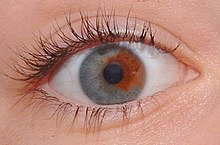
An example of sectoral heterochromia. The subject has a blue iris with a dark-brown department.
Heterochromia (heterochromia iridum or heterochromia iridis) is an eye condition in which one iris is a different color from the other (complete heterochromia), or where a role of 1 iris is a different colour from the balance (partial heterochromia or sectoral heterochromia). Information technology is a result of the relative excess or lack of pigment within an iris or part of an iris, which may be inherited or acquired by disease or injury.[xc] This uncommon status normally results due to uneven melanin content. A number of causes are responsible, including genetic, such equally chimerism, Horner'due south syndrome and Waardenburg syndrome.
A bubble tin can have two different colored eyes just like any two siblings tin—because each cell has dissimilar eye colour genes. A mosaic can accept 2 different colored eyes if the Dna divergence happens to be in an eye-color gene.
There are many other possible reasons for having ii different-colored eyes. For instance, the moving-picture show actor Lee Van Cleef was built-in with ane bluish eye and one green center, a trait that reportedly was mutual in his family, suggesting that it was a genetic trait. This anomaly, which film producers thought would be disturbing to motion-picture show audiences, was "corrected" past having Van Cleef wear dark-brown contact lenses.[91] David Bowie, on the other mitt, had the advent of different eye colors due to an injury that caused 1 pupil to be permanently dilated.
Another hypothesis about heterochromia is that information technology can result from a viral infection in utero affecting the development of one eye, possibly through some sort of genetic mutation. Occasionally, heterochromia can be a sign of a serious medical status.
A common cause in females with heterochromia is 10-inactivation, which can result in a number of heterochromatic traits, such as calico cats. Trauma and certain medications, such equally some prostaglandin analogues, can also cause increased pigmentation in one eye.[92] On occasion, a difference in center color is caused by blood staining the iris afterwards injury.
Impact on vision
Although people with lighter eye color are mostly more sensitive to low-cal because they take less pigment in the iris to protect them from sunlight, there is little to no evidence that heart color has a direct impact on vision qualities such as visual acuity.[93] However, at that place is a study that found that dark-eyed people perform better at "reactive-type tasks", which suggests they may accept improve reaction times.[94] People with light-colored eyes, however, performed meliorate at so-called "self-paced tasks", which include activities like hitting a golf ball or throwing baseballs.[94] In another study, people with darker eyes performed better at hit racquetballs.[95] In that location are besides other studies that challenge those findings.[96] According to scientists, more report is needed to verify these results.[93]
See also
- Hair color
- Iridology
- Human skin color
- Xanthophore
- List of Mendelian traits in humans
References
- ^ Wielgus AR, Sarna T (2005). "Melanin in human irides of different color and age of donors". Pigment Cell Res. 18 (6): 454–64. doi:10.1111/j.1600-0749.2005.00268.ten. PMID 16280011.
- ^ Prota G, Hu DN, Vincensi MR, McCormick SA, Napolitano A (1998). "Label of melanins in homo irides and cultured uveal melanocytes from eyes of dissimilar colors". Exp. Heart Res. 67 (iii): 293–nine. doi:x.1006/exer.1998.0518. PMID 9778410.
- ^ a b c Fox, Denis Llewellyn (1979). Biochromy: Natural Coloration of Living Things. University of California Press. ISBN978-0-520-03699-4.
- ^ a b c Huiqiong Wang; Lin, Due south.; Xiaopei Liu; Sing Bing Kang (2005). "Separating reflections in man iris images for illumination estimation". Tenth IEEE International Briefing on Reckoner Vision (ICCV'05) Volume i. pp. 1691–1698 Vol. 2. CiteSeerXten.i.1.87.418. doi:10.1109/ICCV.2005.215. ISBN978-0-7695-2334-7. S2CID 2215768.
- ^ Sturm R.A. & Larsson K., Genetics of human iris colour and patterns, Pigment Cell Melanoma Res, 22:544-562, 2009.
- ^ a b Mason, Clyde West. (1924). "Blue Optics". Journal of Physical Chemistry. 28 (5): 498–501. doi:10.1021/j150239a007.
- ^ Oliphant LW (1987). "Pteridines and purines equally major pigments of the avian iris". Paint Cell Res. 1 (2): 129–31. doi:x.1111/j.1600-0749.1987.tb00401.x. PMID 3507666.
- ^ Morris, PJ. "Phenotypes and Genotypes for human eye colors." Athro Limited website. Retrieved 10 May 2006.
- ^ a b White, Désirée; Rabago-Smith, Montserrat (xiv October 2010). "Genotype–phenotype associations and human being centre color". Journal of Human being Genetics. 56 (i): 5–seven. doi:10.1038/jhg.2010.126. PMID 20944644.
- ^ No Single Gene For Middle Colour, Researchers Prove. Sciencedaily.com (22 February 2007). Retrieved on 2011-12-23.
- ^ "Eye color definition – Medical Dictionary definitions of popular medical terms easily defined on MedTerms". Medterms.com. 29 Oct 2003. Retrieved 19 October 2011.
- ^ a b Duffy, David L.; Montgomery, Grant W.; Chen, Wei; Zhao, Zhen Zhen; Le, Lien; James, Michael R.; Hayward, Nicholas K.; Martin, Nicholas G.; Sturm, Richard A. (2007). "A 3-single-nucleotide polymorphism haplotype in intron 1 of OCA2 explains most human center-color variation". Am. J. Hum. Genet. 80 (2): 241–52. doi:10.1086/510885. PMC1785344. PMID 17236130.
- ^ a b Sturm RA, Frudakis TN (2004). "Middle colour: portals into pigmentation genes and ancestry" (PDF). Trends Genet. 20 (eight): 327–32. doi:x.1016/j.tig.2004.06.010. PMID 15262401. Archived from the original (PDF) on 9 September 2006.
- ^ a b c Grant MD, Lauderdale DS (2002). "Cohort effects in a genetically determined trait: eye colour among United states of america whites". Ann. Hum. Biol. 29 (6): 657–66. doi:10.1080/03014460210157394. PMID 12573082. S2CID 25364754.
- ^ "DNA examination for center colour could assist fight crime", New Scientist 14 March 2009. Liu, Fan; Van Duijn, Kate; Vingerling, Johannes R.; Hofman, Albert; Uitterlinden, André Chiliad.; Janssens, A. Cecile J.W.; Kayser, Manfred (2009). "Eye colour and the prediction of complex phenotypes from genotypes". Current Biology. 19 (5): R192–R193. doi:10.1016/j.cub.2009.01.027. PMID 19278628.
- ^ Kayser, Manfred; Liu, Fan; Janssens, A. Cecile J.W.; Rivadeneira, Fernando; Lao, Oscar; Van Duijn, Kate; Vermeulen, Marker; Arp, Pascal; et al. (2008). "Three genome-broad association studies and a linkage analysis identify HERC2 as a man iris colour gene". Am. J. Hum. Genet. 82 (2): 411–23. doi:ten.1016/j.ajhg.2007.ten.003. PMC2427174. PMID 18252221.
- ^ a b c d e Sulem, Patrick; Gudbjartsson, Daniel F; Stacey, Simon N; Helgason, Agnar; Rafnar, Thorunn; Magnusson, Kristinn P; Manolescu, Andrei; Karason, Ari; et al. (2007). "Genetic determinants of hair, eye and pare pigmentation in Europeans". Nat. Genet. 39 (12): 1443–52. doi:10.1038/ng.2007.13. PMID 17952075. S2CID 19313549.
- ^ Liu, Fan; Wollstein, Andreas; Hysi, Pirro G.; Ankra-Badu, Georgina A.; Spector, Timothy D.; Park, Daniel; Zhu, Gu; Larsson, Mats; Duffy, David L.; Montgomery, Grant Westward.; MacKey, David A.; Walsh, Susan; Lao, Oscar; Hofman, Albert; Rivadeneira, Fernando; Vingerling, Johannes R.; Uitterlinden, André G.; Martin, Nicholas G.; Hammond, Christopher J.; Kayser, Manfred (2010). "Digital Quantification of Human being Center Color Highlights Genetic Association of Three New Loci". PLOS Genetics. 6 (5): e1000934. doi:10.1371/periodical.pgen.1000934. PMC2865509. PMID 20463881.
- ^ Haak, Westward.; Lazaridis, I.; Patterson, Due north.; Rohland, N.; Mallick, S.; Llamas, B.; Brandt, G.; Nordenfelt, S.; Harney, E.; Stewardson, K.; Fu, Q.; Mittnik, A.; Bánffy, Due east.; Economou, C.; Francken, Thou.; Friederich, S.; Pena, R. 1000.; Hallgren, F.; Khartanovich, V.; Khokhlov, A.; Kunst, M.; Kuznetsov, P.; Meller, H.; Mochalov, O.; Moiseyev, Five.; Nicklisch, N.; Pichler, Due south. L.; Risch, R.; Rojo Guerra, M. A.; et al. (2015). "Massive migration from the steppe was a source for Indo-European languages in Europe". Nature. 522 (7555): 207–211. arXiv:1502.02783. Bibcode:2015Natur.522..207H. bioRxiv10.1101/013433. doi:x.1038/nature14317. PMC5048219. PMID 25731166.
- ^ Mathieson, Iain (2015). "Eight m years of natural choice in Europe". bioRxiv10.1101/016477.
- ^ a b German EJ, Hurst MA, Forest D, Gilchrist J (1998). "A novel system for the objective nomenclature of iris colour and its correlation with response to 1% tropicamide". Ophthalmic Physiol Opt. 18 (2): 103–10. doi:10.1016/S0275-5408(97)00070-7. PMID 9692029.
- ^ Fan S, Dyer CR, Hubbard L. Quantification and Correction of Iris Color." Technical report 1495, University of Wisconsin–Madison, Dec 2003.
- ^ Seddon, JM; CR Sahagian; RJ Glynn; RD Sperduto; ES Gragoudas (1 Baronial 1990). "Evaluation of an iris color classification system". Investigative Ophthalmology & Visual Science. 31 (8): 1592–viii. PMID 2201662. Retrieved 19 October 2011.
- ^ Jones, S.L.; Schnirel, B.L. (2006). "Subspecies comparison of the Genus: Corucia". Polyphemos. 4 (1): 1–25. Archived from the original on ii Feb 2009.
- ^ Color Perception Archived twenty October 2006 at the Wayback Machine. Edromanguitars.com. Retrieved on 23 December 2011.
- ^ "Frost: Why Practise Europeans Accept And so Many Hair and Eye Colors?". cogweb.ucla.edu . Retrieved 27 Feb 2018.
- ^ Burroughs, A. and Leifer, G. (2001) Maternity Nursing: An Introductory Text, W.B. Saunders Medical, p. 172
- ^ Bito, LZ; Matheny, A; Cruickshanks, KJ; Nondahl, DM; Carino, OB (1997). "Eye Color Changes Past Early Babyhood". Archives of Ophthalmology. 115 (5): 659–63. doi:10.1001/archopht.1997.01100150661017. PMID 9152135.
- ^ Solano, F. (2014). "Melanins: Skin Pigments and Much More—Types, Structural Models, Biological Functions, and Germination Routes" [Eye color alter and the affecting factors]. New Periodical of Science. hindawi.com. 2014: 1–28. doi:ten.1155/2014/498276.
- ^ "Man Vision and Colour Perception" [Human Vision and Color Perception]. OLYMPIS. Retrieved 15 June 2021.
- ^ "Ultraviolet (UV) Radiation" [Ultraviolet (UV) Radiation]. American Cancer Gild. Retrieved xvi June 2021.
- ^ Howard Hughes Medical Found: Ask A Scientist Archived ane September 2010 at the Wayback Machine. Hhmi.org. Retrieved on 23 December 2011.
- ^ Larry Bickford Center Colour Archived 23 October 2010 at the Wayback Machine. Eyecarecontacts.com. Retrieved on 23 Dec 2011.
- ^ Oliphant LW (1987). "Observations on the pigmentation of the pigeon iris". Paint Cell Res. 1 (iii): 202–8. doi:10.1111/j.1600-0749.1987.tb00414.x. PMID 3508278.
- ^ Oliphant LW (1981). "Crystalline pteridines in the stromal pigment cells of the iris of the swell horned owl". Cell Tissue Res. 217 (2): 387–95. doi:10.1007/BF00233588. PMID 7237534. S2CID 8061493.
- ^ a b Lefohn A, Budge B, Shirley P, Caruso R, Reinhard E (2003). "An Ocularist's Approach to Man Iris Synthesis". IEEE Comput. Graph. Appl. 23 (half dozen): 70–5. doi:10.1109/MCG.2003.1242384.
- ^ "Amber eyes". All About Vision . Retrieved nine May 2021.
- ^ Menon IA, Basu PK, Persad S, Avaria K, Felix CC, Kalyanaraman B (1987). "Is at that place any difference in the photobiological properties of melanins isolated from human bluish and brown eyes?". Br J Ophthalmol. 71 (7): 549–52. doi:10.1136/bjo.71.7.549. PMC1041224. PMID 2820463.
- ^ a b Bryner, Jeanna (31 January 2008). "Genetic mutation makes those brown eyes blue". NBC News. Retrieved 19 October 2009.
- ^ a b Eiberg, Hans; Troelsen, Jesper; Nielsen, Mette; Mikkelsen, Annemette; Mengel-From, Jonas; Kjaer, Klaus Westward.; Hansen, Lars (2008). "Blueish eye color in humans may exist acquired by a perfectly associated founder mutation in a regulatory element located inside the HERC2 gene inhibiting OCA2 expression". Hum. Genet. 123 (two): 177–87. doi:10.1007/s00439-007-0460-x. PMID 18172690. S2CID 9886658.
- ^ Highfield, Roger (30 January 2008). "Blue optics consequence of aboriginal genetic 'mutation'". The Daily Telegraph. London. Archived from the original on 1 Nov 2009. Retrieved 19 Oct 2011.
- ^ Cavalli-Sforza, Luigi Luca; Cavalli-Sforza, Luca; Menozzi, Paolo; Piazza, Alberto (1994). The History and Geography of Homo Genes . Princeton Academy Press. ISBN978-0-691-08750-four. [ folio needed ]
- ^ "Distribution of Bodily Characters. Pigmentation, the Pilous System, and Morphology of the Soft Parts". Archived from the original on 26 July 2011.
- ^ Blueish eyed Koala. Adelaidenow.com.au (11 January 2008). Retrieved on 2011-12-23.
- ^ "Blue eyes are peeping across U.k.". The Times . Retrieved 8 June 2020.
- ^ "A Single Deoxyribonucleic acid Difference in the HERC2 Gene Explains Blue Eyes | Understanding Genetics". genetics.thetech.org. Retrieved 21 December 2015.
- ^ "How one ancestor helped turn our brown optics bluish". The Independent. 31 January 2008. Retrieved 21 December 2015.
- ^ "All Bluish-Eyed People Accept This Ane Thing in Common". IFLScience . Retrieved 21 December 2015.
- ^ "How Europeans evolved white skin". Scientific discipline | AAAS. 2 April 2015.
- ^ a b c d Debrowski, Adam. "Which Eye Colors Are the Rarest?". All About Vision . Retrieved 4 Feb 2021.
- ^ Belkin, Douglas (18 October 2006). "Blue eyes are increasingly rare in America - Americas - International Herald Tribune (Published 2006)". The New York Times. ISSN 0362-4331. Retrieved 2 February 2021.
- ^ Belkin, Douglas (17 October 2006). "Don't information technology brand my blueish eyes brownish Americans are seeing a dramatic colour change". The Boston World. Archived from the original on 22 Oct 2014.
- ^ Kastelic, V; Pośpiech, E; Draus-Barini, J; Branicki, Due west; Drobnič, K (2013). "Prediction of middle colour in the Slovene population using the IrisPlex SNPs". Croat. Med. J. 54 (4): 381–6. doi:10.3325/cmj.2013.54.381. PMC3760663. PMID 23986280.
- ^ a b Play a trick on, Denis Llewellyn (1979). Biochromy: Natural Coloration of Living Things. University of California Printing. p. ix. ISBN978-0-520-03699-4.
- ^ Eiberg H, Mohr J (1996). "Assignment of genes coding for brown eye colour (BEY2) and brownish hair color (HCL3) on chromosome 15q". Eur. J. Hum. Genet. 4 (iv): 237–41. doi:ten.1159/000472205. PMID 8875191. S2CID 26700451.
- ^ Online Mendelian Inheritance in Man (OMIM): Pare/Hair/Eye PIGMENTATION, VARIATION IN, 1; SHEP1 - 227220
- ^ a b Lucy Southworth. "Are gray eyes the same equally bluish in terms of genetics?". Understanding Genetics: Human Wellness and the Genome. Stanford Schoolhouse of Medicine. Archived from the original on 27 September 2011. Retrieved xix October 2011.
- ^ (in French) Provincia: bulletin trimestriel de la Société de Statistique ..., Volumes 16–17 By Société de statistique, d'histoire et d'archéologie de Marseille et de Provence p. 273 l'iris gris est celui des chaouias...
- ^ Iliad 1:206 http://www.perseus.tufts.edu/hopper/text?doctor=Perseus%3Atext%3A1999.01.0133%3Abook%3D1%3Acard%3D206
- ^ "Gray eyes". All Most Vision . Retrieved nine May 2021.
- ^ OCA2: The Cistron for Color. allaboutgenes.weebly.com. Retrieved on 8 September 2016.
- ^ Keyser, Christine; Bouakaze, Caroline; Crubézy, Eric; Nikolaev, Valery G.; Montagnon, Daniel; Reis, Tatiana; Ludes, Bertrand (2009). "Ancient DNA provides new insights into the history of south Siberian Kurgan people". Human being Genetics. 126 (three): 395–410. doi:10.1007/s00439-009-0683-0. PMID 19449030. S2CID 21347353.
Indeed, among the SNPs tested was rs12913832, a single Dna variation within a regulatory chemical element of HERC2 cistron which is associated to blueish heart colour in humans. This polymorphism, together with the diplotypes obtained from variations of the OCA2 locus (major contributor to the human eye color variation) showed that at least sixty% of the ancient Siberian specimens under study had blue (or light-green) optics.
- ^ Blueish Optics Versus Brownish Optics: A Primer on Eye Colour Archived 8 December 2012 at archive.today. Eyedoctorguide.com. Retrieved on 23 December 2011.
- ^ Why Do Europeans Accept And then Many Hair and Eye Colors?. Cogweb.ucla.edu. Retrieved on 23 December 2011.
- ^ "Why Edinburgh residents are probable to be bluish-eyed". Edinburghnews.Scotsman. Archived from the original on 23 September 2015. Retrieved fourteen February 2015.
- ^ Pálsson, Snaebjörn; Sulem, Patrick. "Genetic determinants of hair, centre and pare pigmentation in Europeans". ResearchGate . Retrieved 21 Feb 2022.
- ^ Moyer, Nancy (21 November 2019). "Eye Colour Percentage for Across the Globe". Healthline . Retrieved two February 2021.
- ^ Walsh, Susan; Wollstein, Andreas; Liu, Fan; Chakravarthy, Usha; Rahu, Mati; Seland, Johan H.; Soubrane, Gisele; Tomazzoli, Laura; Topouzis, Fotis; Vingerling, Johannes R.; Vioque, Jesus; Fletcher, Astrid E.; Ballantyne, Kaye N.; Kayser, Manfred (2012). "Dna-based eye colour prediction across Europe with the Iris Plex system". Forensic Science International: Genetics. half dozen (3): 330–340. doi:x.1016/j.fsigen.2011.07.009. PMID 21813346. (subscription required)
- ^ a b Zhu, Gu; Evans, David G.; Duffy, David L.; Montgomery, Grant Westward.; Medland, Sarah E.; Gillespie, Nathan A.; Ewen, Kelly R.; Jewell, Mary; Liew, Yew Wah; Hayward, Nicholas K.; Sturma, Richard A.; Trenta, Jeffrey M.; Martina, Nicholas Thousand. (2004). "A genome scan for eye color in 502 twin families: about variation is due to a QTL on chromosome 15q". Twin Res. vii (2): 197–210. doi:10.1375/136905204323016186. PMID 15169604.
- ^ Albert, Daniel Thousand; Green, W Richard; Zimbric, Michele L; Lo, Cecilia; Gangnon, Ronald E; Hope, Kirsten L; Gleiser, Joel (2003). "Iris melanocyte numbers in Asian, African American, and Caucasian irides". Transactions of the American Ophthalmological Lodge. 101: 217–222. PMC1358991. PMID 14971580.
- ^ a b Mitchell R, Rochtchina E, Lee A, Wang JJ, Mitchell P (2003). "Iris colour and intraocular pressure level: the Bluish Mountains Middle Study". Am. J. Ophthalmol. 135 (3): 384–half dozen. doi:10.1016/S0002-9394(02)01967-0. PMID 12614760.
{{cite journal}}: CS1 maint: url-status (link) - ^ Lindsey JD, Jones HL, Hewitt EG, Angert Thousand, Weinreb RN (2001). "Induction of tyrosinase gene transcription in man iris organ cultures exposed to latanoprost". Arch. Ophthalmol. 119 (6): 853–lx. doi:ten.1001/archopht.119.6.853. PMID 11405836.
- ^ a b Frank RN, Puklin JE, Stock C, Canter LA (2000). "Race, iris color, and historic period-related macular degeneration". Trans Am Ophthalmol Soc. 98: 109–fifteen, discussion 115–seven. PMC1298217. PMID 11190014.
- ^ a b Regan S, Judge HE, Gragoudas ES, Egan KM (1999). "Iris color equally a prognostic factor in ocular melanoma". Arch. Ophthalmol. 117 (6): 811–four. doi:10.1001/archopht.117.six.811. PMID 10369595.
- ^ Hawkins TA, Stewart WC, McMillan TA, Gwynn DR (1994). "Analysis of diode, argon, and Nd: YAG peripheral iridectomy in cadaver eyes". Doc Ophthalmol. 87 (4): 367–76. doi:ten.1007/BF01203345. PMID 7851220. S2CID 30893783.
- ^ Hammond BR, Fuld K, Snodderly DM (1996). "Iris color and macular pigment optical density". Exp. Centre Res. 62 (3): 293–7. doi:10.1006/exer.1996.0035. PMID 8690039.
- ^ NOAH – What is Albinism? Archived 14 May 2012 at the Wayback Car. Albinism.org. Retrieved on 23 December 2011.
- ^ Dave Johnson (16 Jan 2009). "HOW TO: Avert the carmine eye outcome". New Zealand PC Globe. Archived from the original on 24 February 2010. Retrieved ix January 2010.
- ^ Palmer, Roxanne (25 March 2005). "Elizabeth Taylor: Cute Mutant". Slate. Archived from the original on 27 March 2011. Retrieved 26 March 2011.
- ^ a b "The World's Population By Centre Color". WorldAtlas. six October 2020. Retrieved x May 2021.
- ^ Nicolas, Caroline M; Robman, Luba D; Tikellis, Gabriella; Dimitrov, Peter N; Dowrick, Adam; Guymer, Robyn H; McCarty, Catherine A (2003). "Iris colour, ethnic origin and progression of age-related macular degeneration". Clin. Experiment. Ophthalmol. 31 (6): 465–nine. doi:ten.1046/j.1442-9071.2003.00711.x. PMID 14641151. S2CID 25878963.
- ^
- ^ Stang A, Ahrens West, Anastassiou Thou, Jöckel KH (2003). "Phenotypical characteristics, lifestyle, social class and uveal melanoma". Ophthalmic Epidemiol. 10 (5): 293–302. doi:ten.1076/opep.x.5.293.17319. PMID 14566630. S2CID 1592701.
- ^ Cumming RG, Mitchell P, Lim R (2000). "Iris colour and cataract: The Blue Mountains Eye Study". American Journal of Ophthalmology. 130 (2): 237–238. doi:10.1016/S0002-9394(00)00479-seven. PMID 11004303.
- ^ McDonnell M, Esmonde T (1999). "A homesick student". Postgrad Med J. 75 (884): 375–8. doi:x.1136/pgmj.75.884.375. PMC1741256. PMID 10435182.
- ^ a b de la Maza, Maite Sainz; Tauber, Joseph; Foster, C. Stephen (2012). "Noninflammatory Diseases of the Sclera". The Sclera. pp. 277–297. doi:10.1007/978-1-4419-6502-8_8. ISBN978-1-4419-6501-1.
- ^ Wheatley, TJ (2006). "Upper gastrointestinal surgery". In Kingsnorth, Andrew Northward; Majid, Aljafri A (eds.). Fundamentals of Surgical Exercise. pp. 230–248. doi:10.1017/CBO9780511545740.013. ISBN978-0-511-54574-0.
- ^ Aniridia at eMedicine
- ^ Ocular Manifestations of Albinism at eMedicine
- ^ Imesch PD, Wallow IH, Albert DM (1997). "The color of the human centre: a review of morphologic correlates and of some atmospheric condition that bear on iridial pigmentation". Surv Ophthalmol. 41 (Suppl 2): S117–23. doi:10.1016/S0039-6257(97)80018-5. PMID 9154287.
- ^ Biography for Lee Van Cleef at IMDb
- ^ Hejkal TW, Camras CB (1999). "Prostaglandin analogs in the treatment of glaucoma". Seminars in Ophthalmology. fourteen (iii): 114–23. doi:ten.3109/08820539909061464. PMID 10790575.
- ^ a b O'Connor, Anahad (nineteen January 2009). "The Claim: Eye Color Can Have an Upshot on Vision". The New York Times. ISSN 0362-4331. Retrieved 5 May 2021.
- ^ a b Miller, Fifty. K.; Rowe, P. J.; Lund, J. (August 1992). "Correlation of heart color on self-paced and reactive motor performance". Perceptual and Motor Skills. 75 (i): 91–95. doi:ten.2466/pms.1992.75.one.91. ISSN 0031-5125. PMID 1528697. S2CID 31398375.
- ^ Rowe, P. J.; Evans, P. (August 1994). "Ball colour, heart color, and a reactive motor skill". Perceptual and Motor Skills. 79 (1 Pt 2): 671–674. doi:10.2466/pms.1994.79.i.671. ISSN 0031-5125. PMID 7808908. S2CID 6743916.
- ^ Crowe, M.; O'Connor, D. (October 2001). "Heart colour and reaction fourth dimension to visual stimuli in rugby league players". Perceptual and Motor Skills. 93 (2): 455–460. doi:10.2466/pms.2001.93.two.455. ISSN 0031-5125. PMID 11769902. S2CID 22785194.
External links
- genetics.thetech.org
- Eye Colour and Human Diseases
Source: https://en.wikipedia.org/wiki/Eye_color
0 Response to "what do you call a persons eyes that change from blue to green to grey"
Postar um comentário